
Learning conducting patterns: the 2-beat, 3-beat and 4-beat pattern explained simply
When you start conducting, there's really only one thing you want to know: how do I move my hand so the choir knows where the beat is. And then you find fifteen tutorials online, each showing you fifteen slightly different versions, and by the end you're more confused than before.
So let's clean this up. The three beat patterns you actually need to get started: the 2-beat, the 3-beat, and the 4-beat pattern. For each one, I'll also show you the mistake almost everyone makes at the start, myself included.
First: the ictus and the beat plane
Before we get to the patterns, one thing that applies to all of them. Every beat pattern, no matter which one, builds toward a single moment: the moment your hand arrives at the very bottom and briefly reverses. That's the ictus. And that exact moment is when your choir sings.
At first, this is purely a question of timing, not location. The ictus is a point in time: now. When that moment is clear, the choir knows exactly when to come in. When it blurs, the choir guesses. And a guessing choir sounds like one.
Now location comes into it too, and that's a separate matter. All these ictus points should happen at the same height, roughly chest height. Picture an invisible tabletop in front of you. Every beat lands on that tabletop, always at the same height.
The distinction matters: the ictus is the when. The beat plane is the where. You can hit the right moment and still place it high one time, low the next, and then the choir has the timing but no steady visual picture. Both together, same moment, same height, that's what makes the choir feel secure.
The 2-beat pattern: down, up
Let's start simple. The 2-beat pattern has two beats and two directions: down, up.
Beat one falls downward and arrives on the plane. Beat two goes back up.
The typical beginner mistake here: it gets too round, too soft, the two directions blur into a kind of circular motion, and suddenly the choir no longer knows which way was up and which was down. The two directions need to stay visibly two directions.
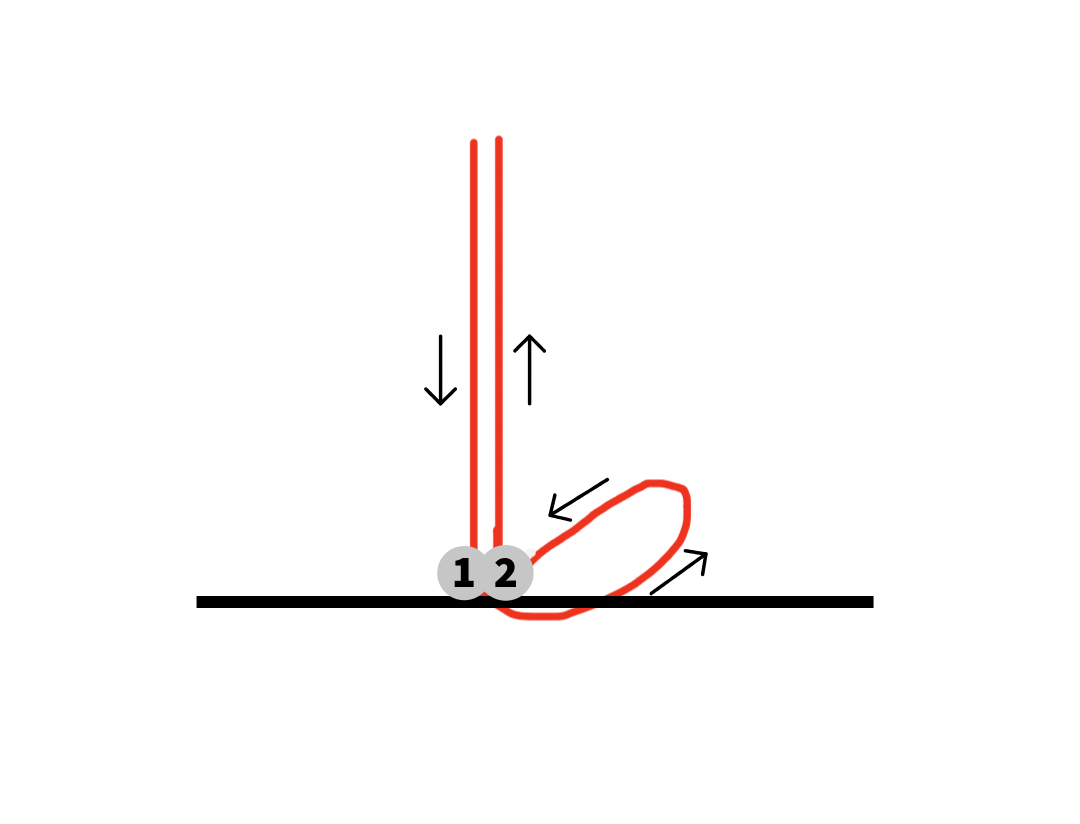
The 3-beat pattern: down, out, up
The 3-beat pattern has three clearly distinct directions: down, out, up.
One goes down. Two goes out. Three goes back up.
This is the classic 3-beat mistake: beat two heads back up too early, and suddenly your 3-beat pattern looks like a 2-beat pattern that lost its way. Consciously think "out." Your choir will thank you.

The 4-beat pattern: down, in, out, up
The 4-beat pattern is the meter you'll run into most often in choral music. Four beats: down, in, out, up.
One down. Two toward the inside, toward your body's center. Three toward the outside, away from your body. Four back up.
The heart of the 4-beat pattern is the contrast between in and out. Beat two and beat three need to go clearly different directions. If both drift into the same corner, the choir loses the middle of the bar.

The three most common mistakes
Before you start practicing, the three mistakes I see most often. And I'll start with the one so obvious that nobody ever says it out loud.
The first: you're staring at the score the whole time. Sounds ridiculous, but it's the most common one of all. If your eyes are glued to the sheet music, all the choir sees is the top of your head, and nobody can follow the top of a head. Look up. It's the cheapest improvement there is, and it costs zero technique.
The second: no steady height. The hand beats sometimes high, sometimes low, the beat plane drifts, and the choir loses the steady visual picture.
The third: blurred directions. Everything gets beaten so soft and round that you can no longer tell the 2-beat, 3-beat, and 4-beat patterns apart. The pattern becomes unrecognizable.
How to practice without a choir
The question I get asked most often: how do I even practice this when there's no choir around? Three things.
The mirror. Conduct, and actually watch: what would a choir see?
The metronome. Hit the ictus exactly on the click, not approximately.
And record yourself. It's uncomfortable, I know, nobody likes watching themselves conduct. But you'll see more of your own quirks in thirty seconds of video than in a month of practicing in front of the mirror.
Get the free guide
If you want to know what other mistakes I see most often and how to fix them quickly: I've put together the ten most common conducting mistakes in a free guide.
Get it, practice with it in front of the mirror, and your next time in front of the choir will be a different story.
In the next article I'll tackle the pattern I deliberately left out here: the 6-beat pattern. It has two faces and deserves its own post.


Comments